



It is a marine creature with a complex physiology and an intelligence that stands out among invertebrates. Capable of a long memory, which allows it to draw on previous experiences
and capable of assessing the merits of choices regarding daily food procurement. These qualities are accompanied by an extremely refined and effective ability to blend in with other marine inhabitants—yet this does not protect it from its primary and most formidable predator: man.
Sepia officinalis—the common Mediterranean cuttlefish—belongs to the large Sepiidae family, which comprises various species of this mollusk found in seas and oceans across temperate and tropical zones. A notable exception is the American coasts of both the Pacific and Atlantic Oceans. The Mediterranean species is also found along the Atlantic coasts of Europe and in the North Sea.
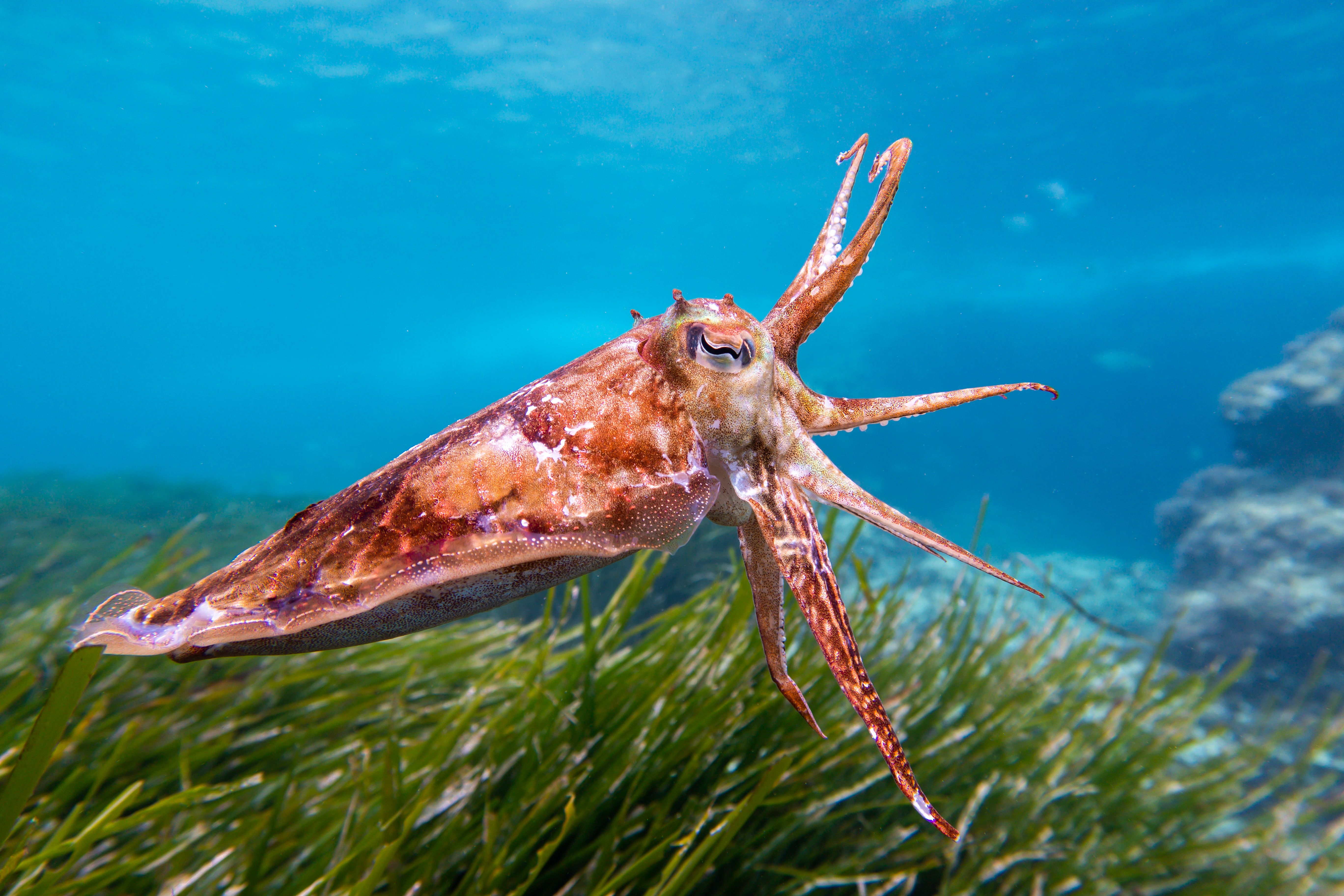
Cuttlefish primarily inhabit offshore seabeds—whether muddy or sandy—and can be found among seagrass beds and at depths exceeding one hundred meters; however, thanks to their excellent swimming abilities, they move throughout the water column as needed.
In spring, they begin a mass migration toward the coast, as this is where reproduction—the final act of their lives—takes place. Indeed, the Mediterranean species lives only between 18 and 30 months; it reaches sexual maturity between 14 and 18 months and reproduces only once. Both males and females die after ensuring the next generation: the males by fertilizing the eggs, and the females by laying them in distinctive black clusters known as "sea pinecones", attaching them to a wide variety of supports, including marine plants. The eggs take a few weeks to hatch. Fully formed young, already capable of hunting, emerge from them. Besides serving as food for many marine animals, the young cuttlefish are also preyed upon by adults of their own species—a case of cannibalism.
The cuttlefish has a stout, oval-shaped body that can reach lengths of 50 centimeters in males and 29 centimeters in females, with a maximum weight of up to 12 kilograms. Its body is fringed by fins and, like all other decapod cephalopods, it possesses ten sucker-bearing tentacles: eight attached near the mouth and two longer, retractable ones used to capture prey. Prey is seized with lightning-fast movements, trapped by specialized suckers concentrated at the tips of the long tentacles, poisoned, and easily consumed using the horny beak located right between the tentacles. A carnivorous animal, the cuttlefish feeds on small fish, crustaceans, and other mollusks—including juveniles of its own species, particularly during periods of territorial overcrowding or when other food sources are scarce.
The mouth and beak are located in the mollusk's head, which also houses two protruding eyes covered by a transparent membrane and featuring W-shaped pupils. The head contains the cartilaginous capsule that protects the animal's large brain. Among all invertebrates, the Mediterranean cuttlefish boasts the highest brain-to-body size ratio. Its brain comprises 170 million neurons and thirty specialized functional areas, accounting for the animal's intelligence.
One of the brain's functions is to govern a highly sophisticated nervous system—upon which it also relies—that is crucial for the mollusk's survival; this system controls the countless chromatophores, the skin cells that enable the creature to masterfully blend into any environment. Chromatophores serve not only for camouflage—used for defense, intimidating enemies, and hunting—but also for communication with other cuttlefish. Each chromatophore contains various pigments, allowing it to change color in response to external chemical stimuli. Based on these, the animal is able to alter its base coat coloration and create specific patterns in certain situations—such as the black-and-white striped coat displayed by males during courtship, or the white spots females use to communicate with one another.
The body houses all the other organs, including three hearts: one that pumps oxygenated blood to the other organs, and two that pump blood through the gills for oxygenation. The blood contains hemocyanin, making it blue. The cavity containing the various organs connects to a siphon used for respiration and locomotion, enabling the animal to quickly escape danger.
The mantle contains a shell known as the cuttlebone (*sepion* or *sepiostaire*); composed primarily of calcium carbonate, it can be filled with gas and liquid, allowing the animal to control its buoyancy and the depth at which it swims.
Beneath the cuttlebone, protected by a sac nestled among the internal organs, lies the ink gland; it produces the ink that is transferred—when needed—to the ink sac located between the gills, from which the protective cloud is released to envelop the cuttlefish in times of danger.
Despite its extraordinary abilities, the cuttlefish serves as prey for large marine predators, including big octopuses, cetaceans, and seabirds. Yet its most formidable enemy is humankind, due to both intensive fishing across all seas and oceans and the release of pollutants into the environment—foremost among them, microplastics. Indeed, the species is considered vulnerable.