


A large protective umbrella and food, always and conveniently available.
It is the large jellyfish of the Mediterranean that ensure these benefits to some species of fish with which they have created a symbiotic relationship and from which they also benefit. Very different marine creatures, such as the astonishing Mediterranean Cassiopeia (Cotylorhiza tuberculata) and the horse mackerel (Trachurus trachurus), protagonists of one of the most characteristic examples of symbiosis offered by our sea.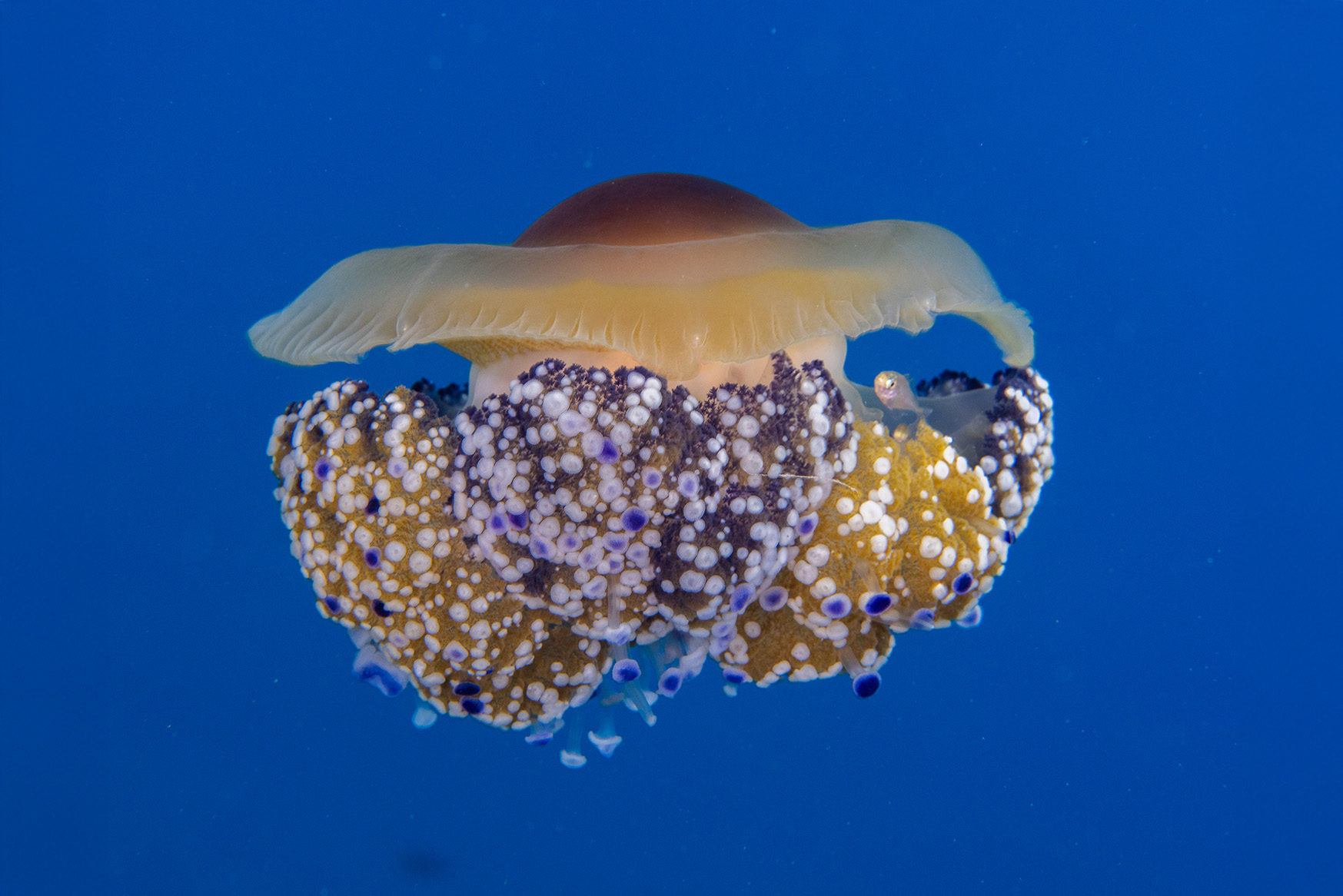 The jellyfish with the fascinating mythological name has a decidedly strange appearance and is so characteristic that it is unmistakable: observed from above, the umbrella appears like a large fried egg, with a bright yellow swelling surrounded by a white disk and is in fact also known as the "fried egg jellyfish".
The edge of the umbrella can take on a greenish color, indicative of the presence of tiny zooxanthellae algae, with which it also maintains a symbiotic relationship, like many other marine animals. Under the umbrella, which can reach thirty centimeters in diameter, like its other sisters belonging to the order of Rhizostomeae, it has arms with numerous ramifications in which the oral orifices through which it feeds are located. The arms, which end with small blue/purple buttons, are therefore not tentacles as in other species of jellyfish and, in the case of Cassiopeia, they do not have stinging cells, so they are also harmless to humans.
Among those filaments, small schools of young horse mackerel find a safe refuge from predators, which also take advantage of the protective jellyfish to easily stock up on food. The jellyfish, in turn, uses the small fish that follow to get rid of parasites and unwelcome guests.
The horse mackerel or suro belongs to the Carangidae family, therefore it is a pelagic bony fish, also present in the Mediterranean, as well as in the Atlantic Ocean and the North Sea. It lives mainly at great depths, up to a thousand meters, but it can also be found at lower depths, closer to the coast, in shady areas. The schools face seasonal migrations to find constant temperatures. The single specimen has an average length of about thirty centimeters, an iridescent green color, silver sides with a black spot on the operculum and one on the pectoral axil with gray dorsal fins, whitish anal and ventral fins, gray-green pectoral and ventral fins.
The symbiosis of juvenile horse mackerel, which are immune to the stinging liquid of jellyfish, does not only concern Cassiopeia, but also the other large jellyfish of the Mediterranean, the sea lung (Rhizostoma pulmo). The same is true for the juveniles of another carangid, the amberjack (Seriola dumerili), and fish of the Sparidae family such as salema (Sarpa salpa) and bogue (Boops boops).
Sono le grandi meduse del Mediterraneo che assicurano questi vantaggi ad alcune specie di pesci con cui hanno creato un rapporto simbiotico e da cui anch’esse traggono benefici. Creature marine molto diverse, come la stupefacente Cassiopea mediterranea (Cotylorhiza tuberculata) e il suro o sugarello (Trachurus trachurus), protagonisti di uno dei più caratteristici esempi di simbiosi offerti dal nostro mare.
La medusa dall’affascinante nome mitologico ha un aspetto decisamente strano e talmente caratteristico da risultare inconfondibile: osservandolo dall’alto, l’ombrello appare come un grande uovo fritto, con un rigonfiamento giallo intenso circondato da un disco bianco ed è nota, infatti, anche come “medusa uovo fritto”. Il margine dell’ombrello può assumere una colorazione verdastra, indicativa della presenza delle minuscole alghe zooxantelle, con cui pure intrattiene un rapporto simbiotico, come molti altri animali marini. Al di sotto dell’ombrello, che può raggiungere i trenta centimetri di diametro, come le altre sorelle appartenenti all’ordine delle Rizostomee ha dei bracci con numerose ramificazioni in cui sono collocati gli orifizi orali attraverso i quali si nutre. I bracci, che terminano con dei piccoli bottoni blu/viola, non sono, dunque, dei tentacoli come in altre specie di meduse e, nel caso della Cassiopea, non hanno cellule urticanti, per cui sono innocui anche per l’uomo. Tra quei filamenti trovano un rifugio sicuro dai predatori i piccoli branchi di giovani sugarelli, che approfittano della medusa protettrice anche per rifornirsi facilmente di cibo. La medusa, a sua volta, si avvale dei pesciolini al seguito per liberarsi di parassiti e ospiti sgraditi.
Il sugarello o suro appartiene alla famiglia dei Carangidi, dunque è un pesce osseo pelagico, presente anche nel Mediterraneo, oltre che nell’Oceano Atlantico e nel Mare del Nord. Vive prevalentemente a grandi profondità, fino ai mille metri, ma si può incontrare anche a profondità minori, più vicino alla costa, in zone ombrose. I banchi affrontano migrazioni stagionali per trovare temperature costanti. Il singolo esemplare ha una lunghezza media di una trentina di centimetri, un colore verde iridescente, fianchi argentati con una macchia nera sull’opercolo e una sull’ascella pettorale con pinne dorsali grigie, pinne anale e ventrali biancastre, pettorali e ventrali grigio-verdi.
La simbiosi dei giovanili di sugarello, che sono immuni al liquido urticante delle meduse, non riguarda solo la Cassiopea, ma anche l’altra grande medusa del Mediterraneo, il polmone di mare (Rhizostoma pulmo). Lo stesso vale anche per i giovanili di un altro carangide, la ricciola (Seriola dumerili), e di pesci della famiglia degli Sparidi come salpa (Sarpa salpa) e boga (Boops boops).