


Its large shell—characterized by a bulbous shape that makes it resemble a small barrel—explains the name by which it is most commonly known, Giant Tun.
This term clearly derives from the spacious dolium used in ancient times to store and transport oil and other foodstuffs. Its scientific name, Tonna galea, also makes explicit reference to both its rounded shape and the object with which it is typically identified: a helmet, or galea in Latin. Indeed, it is one of the largest gastropods in the Mediterranean, and is also found in certain areas of the Atlantic.
The size of its shell is truly remarkable, reaching diameters of 25 or even 30 centimeters and appearing as a spiral of flattened, brownish ridges with lighter shading. However, the foot—the mollusk's muscular body—is even larger, exceeding the size of its "home." With this foot, which is whitish with brown or even black spots, the animal moves easily across sandy and muddy substrates and through the Posidonia seagrass meadows it inhabits—at depths of up to one hundred meters—where it takes refuge during the day by largely burying itself in the sediment.
The T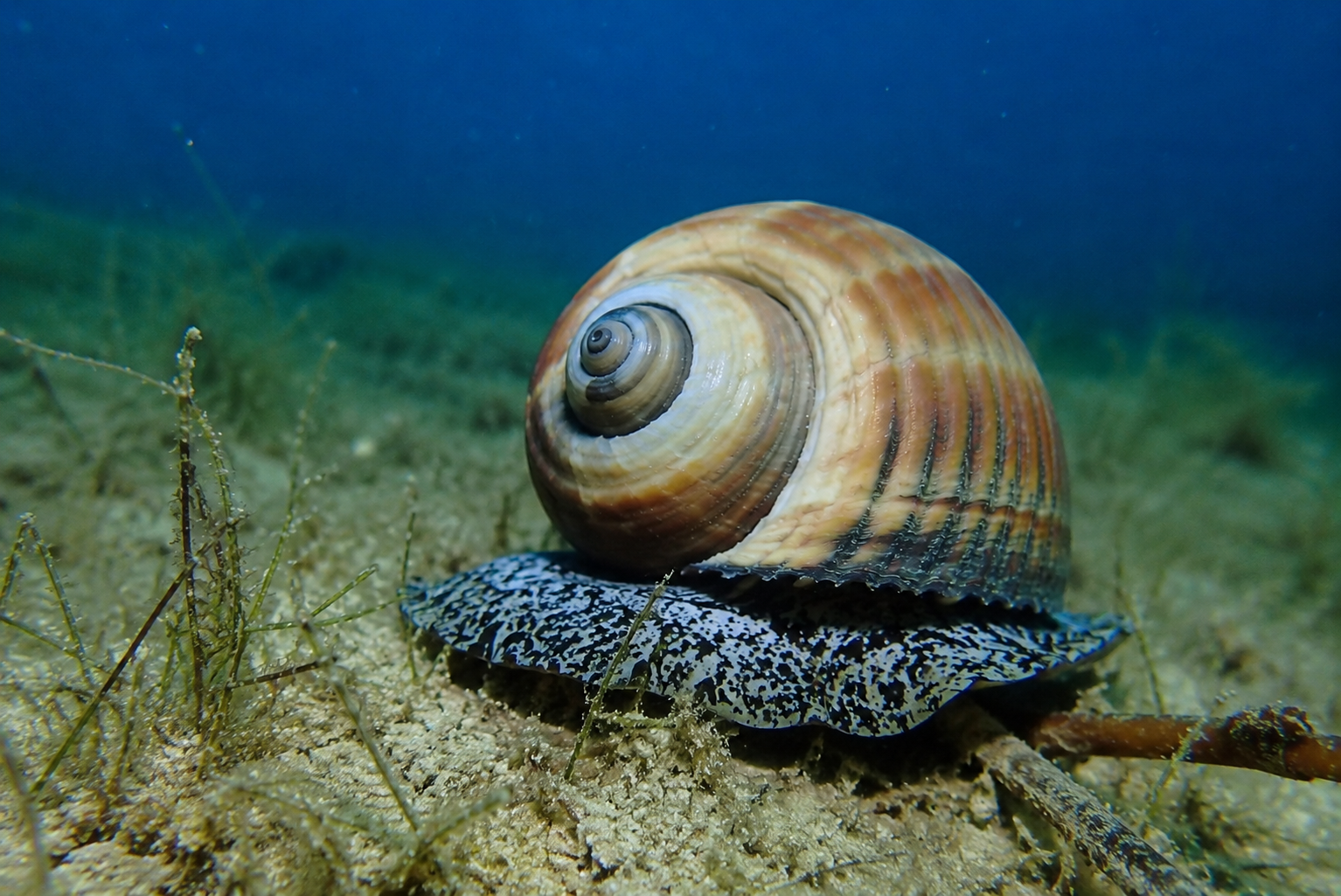 onna is, in fact, a nocturnal predator that prefers low-light conditions for moving and hunting. A carnivore, it feeds on animals sharing its habitat. Its primary and preferred prey are sea cucumbers, specifically the species Holothuria tubulosa. However, it also feeds on bivalves, sea urchins, and other echinoderms, locating them thanks to its powerful sense of smell. This sense—which also aids in finding reproductive partners—relies on specialized organs situated above the siphon, the channel through which water enters to reach the respiratory gills. Once prey is detected, the Tonna deploys its large, extensible, proboscis-like mouth to suck it in and consume it, aided by secretions of sulfuric and aspartic acids from a specialized gland in its gut. These acids kill the prey and even break down the calcareous shells of bivalves.
Towards the end of summer, broad, pinkish ribbons with a fabric-like texture—sometimes reaching a meter in length—begin to appear on the seabed inhabited by the Tonna snail. These are the gastropod’s eggs, encased in a protective, whitish mucus that serves as food for the thousands of embryos during the month required to complete the first stage of their development. Once this period ends, the ribbon dissolves and the larvae are released into the water column, where they live as plankton for approximately seven to eight months. At the end of this second phase, metamorphosis occurs, bringing the young gastropods down to the seabed, where they will spend the rest of their lives.
Due to both its size and its nocturnal habits, the Tonna has few natural predators, although octopuses are particularly fond of it. It is also preyed upon by large carnivores that dig through the sand. However, its populations would not have dwindled to their current levels were it not for human hunting, as the mollusk is edible and its large shell is a collector's item. For these reasons, the gastropod is a protected species under the Bern Convention and the Barcelona Protocol.