
He never gives them up. And every time he moves to a larger shell, he takes care to prepare an adequate accommodation in the new home also for his faithful traveling companions. And life companions. The only ones with whom he agrees to share the “domestic” space in which he notoriously does not like intrusions, not even from his peers.
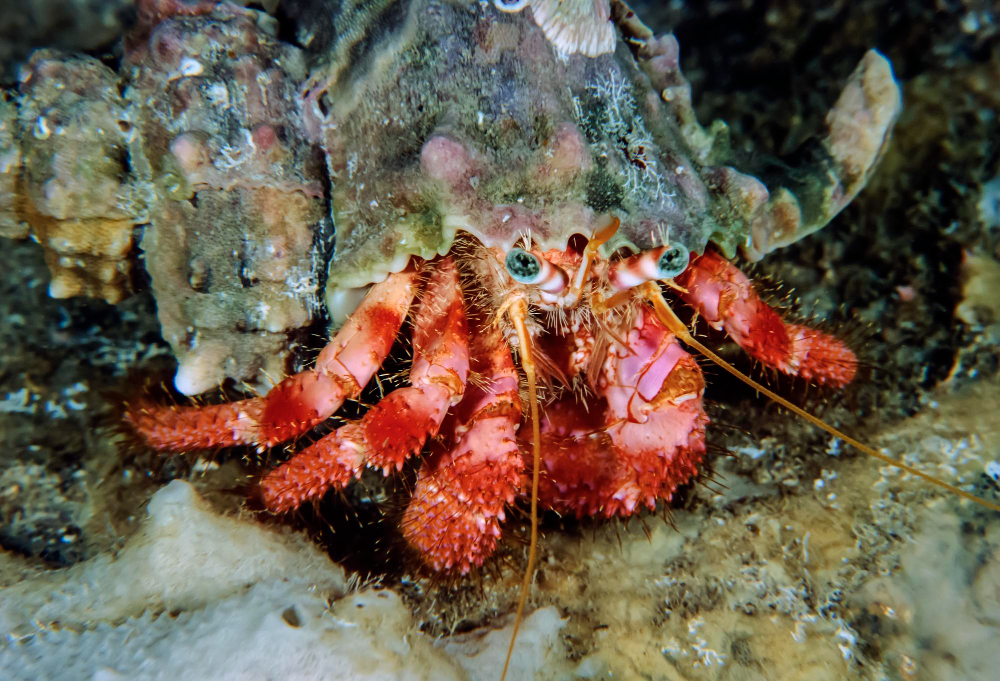
It is no coincidence that, together with the recovery shell adapted from time to time to the new measurements of its growing body, the Paguro Bernardo carries with it that nickname of “hermit” borrowed from its solitary existence. The only exceptions are the anemones anchored on its shell, belonging to the species Calliactis parasinica, which for this consolidated symbiosis is naturally associated with the Pagurus bernhardus.
Community life, the result of a long and complex adaptation, has advantages for everyone. For the hermit crab, which always carries them with it, those polyps represent a precious life-saving protection. Sea anemones, in fact, are cnidarians, anthozoans, hexacorals. Cnidarians, as they have stinging cells that, placed on white filaments called acontia, come out as soon as they are attacked by predators. In this way, the anemones defend themselves and also the hermit crab that hosts them. Furthermore, their presence on the shells, favors their camouflage on the seabed, helping the hermit crab to hide more effectively from its attackers.
Even for sea anemones, the advantage of cohabitation is notable. First of all, thanks to the hermit crab that carries them on its shell, they can move around without any effort and with movement they have a greater chance of feeding. And then they can always make use of the leftovers from their host's meals. The host really takes care of them, willingly accepting their presence on the shell in which it is installed. And furthermore, every time it is forced to change it, it takes care to move one by one the anemones it lives with onto the new shell. Bernardo and his anemones are one of the most astonishing examples of mutualistic symbiosis that is established between the inhabitants of the sea depths.
Non a caso, insieme al guscio di recupero di volta in volta adattato alle nuove misure del suo corpo in crescita, il Paguro Bernardo si porta dietro quell’appellativo di “eremita” mutuato dalla sua esistenza solitaria. A fare eccezione sono proprio le attinie ancorate sulla sua conchiglia, appartenenti alla specie Calliactis parasinica, che per questa consolidata simbiosi è naturalmente associata al Pagurus bernhardus.
La vita in comune, frutto di un lungo e complesso adattamento, ha vantaggi per tutti. Per il paguro, che li porta sempre con sé, quei polipi rappresentano una preziosa protezione salvavita. Le anemoni di mare, infatti, sono cnidari, antozoi, esacoralli. Cnidari, in quanto dotate di cellule urticanti che, poste su filamenti bianchi detti aconzie, fuoriescono non appena vengono attaccate dai predatori. In questo modo, le attinie difendono sé stesse e anche il paguro che le ospita. Inoltre, la loro presenza sulle conchiglie, ne favorisce la mimetizzazione sul fondale, aiutando il paguro a nascondersi più efficacemente dai suoi aggressori.
Anche per le anemoni di mare, il vantaggio della coabitazione è notevole. Innanzitutto, grazie al paguro che se le porta sul guscio, possono spostarsi senza alcuno sforzo e con il movimento hanno maggiori possibilità di nutrirsi. E poi possono sempre usufruire dei residui dei pasti del loro ospite.
Quest’ultimo si prende realmente cura di loro, accettando di buon grado la loro presenza sulla conchiglia in cui è insediato. E inoltre, ogni volta che è costretto a cambiarla, si premura di spostare una ad una sul nuovo guscio anche le attinie con cui convive. Bernardo e le sue attinie sono uno dei più stupefacenti esempi di simbiosi mutualistica che si instaura tra gli abitanti delle profondità marine.