



There are approximately nine hundred species, distributed throughout the planet's seas and oceans, where they play a fundamental role in the balance of all marine habitats. These are sea urchins, organisms as small as they are complex, which over hundreds of millions of years have been able to adapt to the most diverse living conditions in nature. However, they are highly sensitive to climate change and, due to their calcareous dermal skeleton, to increasing ocean acidification. This is without even considering the effects of indiscriminate harvesting for food on the most exposed and declining populations.
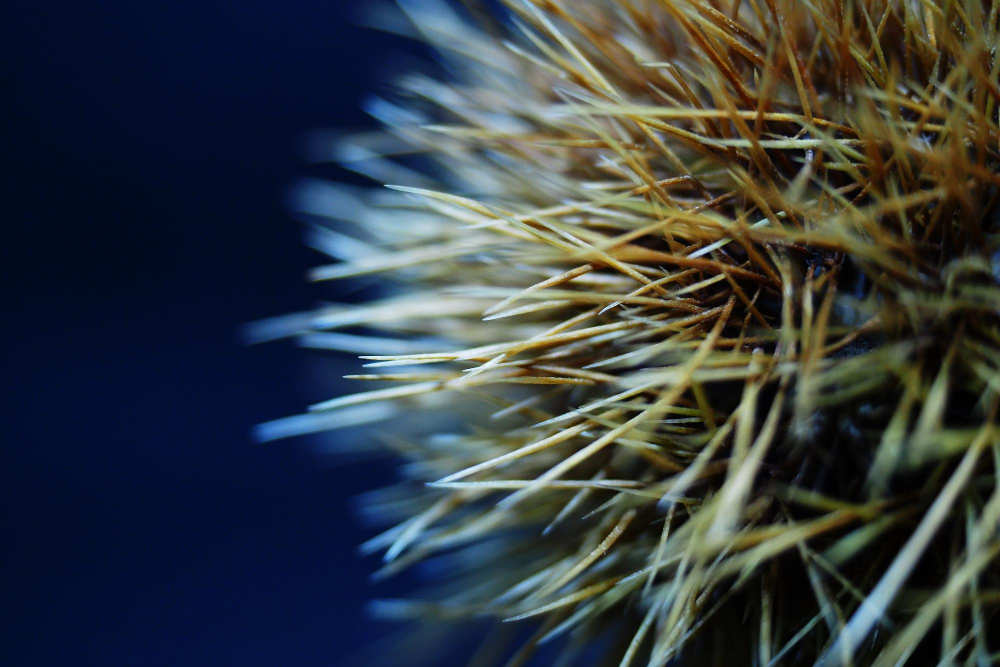
Sea urchins are invertebrates belonging to the echinoderm phylum, along with starfish, sea lilies, brittle stars and sea cucumbers. They share, at some stages of their life, the characteristic of pentaray symmetry and the presence of a dermal skeleton composed of calcareous plates that, in sea urchins, are welded together to form a rigid shell. The plates are also capable of regenerating if partially damaged. The dermal skeleton features the long, mobile spines characteristic of sea urchins, while the ventral ambulacral pedicels protrude from the sea urchin's abdomen, allowing the animal to move, thanks to an internal aquifer system "fed" by seawater.
Sea urchins are classified into regular and irregular echinoids. Originally, they were all regular, meaning they had a spherical shape, pentaradial symmetry, anus facing upwards and mouthparts symmetrically downwards, to allow the animals to graze on the (widely varying) seabeds where they live, as benthic organisms. Regular echinoids are still the most numerous, but starting in the Jurassic, a differentiation occurred. This gave rise to the irregular echinoid species, with heart-shaped or flattened shapes and a characteristic bilateral symmetry, with the anus and mouth positioned obliquely rather than mirroring each other. The mouth, however, is in contact with the sandy or muddy substrate, in which they burrow and take refuge.
Regular echinoids are characterized by a spherical theca that is externally divided into ten sectors: five ambulacral areas, from which the pedicels emerge, and another five interambulacral areas, from which the gametes emerge. The largest of these areas is called the madreporite and has holes to allow the passage of seawater. This serves to operate the aquifer system, which allows the urchin to move, activating the release of the numerous ambulacral pedicels from the theca, which may end in suckers for better adhesion to the substrate. In irregular echinoids, the ambulacral areas are called "petaloid" due to their distinctive petal shape.
The downward-facing mouthparts contain the animal's feeding organ. This organ is called "Aristotle's lantern" because the Greek philosopher was the first to identify and describe it. It consists of five calcareous plates, shaped like a pyramid with the base pointing upward, connected by muscle bundles. The five teeth, located in the pyramids, protrude through these plates. These teeth are used by the animal to scrape the substrate, literally grazing on rocky seabeds, among seaweed beds, or in seagrass meadows. The gills are located in the area around the mouth.
Sea urchins feed primarily on plants, bits of algae, or Posidonia oceanica leaves and other marine plants, but, depending on the food availability in their areas, they may also consume small animals or animal debris. The primary ecological function of sea urchins in the world's seas is linked precisely to their role in the food chain: by feeding on plants, especially algae, they prevent the proliferation that is harmful to the balance of coral reefs and coralligenous seabeds. They are also important as food for other marine animals. Given the hardness of their shells, sea urchins are preyed upon only by sharp-toothed fish such as gilt-head bream and white sea bream, but they can also be eaten by large crustaceans, mollusks, and even starfish, their relatives.
Males and females are identical, making them indistinguishable. Both release their gametes simultaneously into the sea, where fertilization occurs. The larvae, known as "plutei," are characterized by bilateral symmetry and have between six and eight pairs of arms equipped with ciliated bands with which they feed and move through the water column: they are, in fact, planktonic organisms. Only at the end of this phase, which lasts a few months, do the plutei settle on the seabed, where their adult life as benthic organisms begins.