
Discover Italia ti invita a esplorare le meraviglie del pianeta blu

It was 1980 when it was spotted in the waters of Israel, for the first time in the Mediterranean. And since then it has been a slow but progressive expansion towards the west, especially favored in recent years by the increase in sea temperatures, which is particularly affecting the Mediterranean.
A sea that has always hosted fish of the Murenidae family, of which the most widespread representative remains Muraena helena, a close relative of the alien Enchelycore anatina, the official name that identifies the Eastern Moray eel, also known as the “tiger moray eel”. A name, the latter, linked to the bright colors that characterize it, from yellow to orange, to brown, with streaks that can recall the coat of the large terrestrial feline.
From that first report, thirty years passed before we heard about the presence of the snake-like “tiger” in the upper Adriatic, in Croatia. And more than another decade for the first Italian sighting, on the Tremiti Islands, where it made its appearance, at least officially, in 2024, although there is no lack of evidence of previous encounters with the brightly colored moray eel, very different from its local relative with a much more sober brown-blackish color.
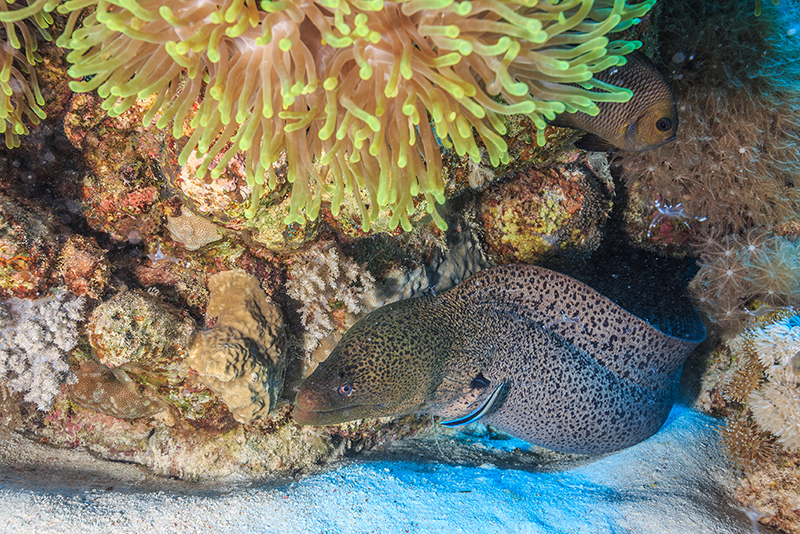
The alien moray eel has its reference area in the western Atlantic, where it is present in the sea of ??the archipelagos of the Canary Islands, Cape Verde, Azores and Madeira. The adult male of the species can reach one and a half meters in length and its teeth are transparent. Apart from its color, it has a behavior common to other members of the Murenidae family: it is carnivorous, preys mainly at night and feeds on fish, crustaceans and molluscs, starting with octopuses, which also live in rocky ravines and are one of its favorite prey. The alien moray eel also lives on rocky seabeds and uses cavities and cracks in the rock as dens. And if at tropical latitudes it inhabits coral reefs, in the Mediterranean it is settled in coralligenous areas.
Serpent-like body, devoid of scales, moray eels lack pectoral and ventral fins, but the dorsal and anal fins extend along the entire length of the body, from head to tail. They are equipped with predatory teeth, with long and pointed teeth, which leave no escape to the prey captured without moving from the den, with a lightning-fast and implacable snap.
The original distribution area was already very wide: from the Sea of ??Japan to Australia, from Polynesia to Southeast Asia, practically the entire tropical and subtropical Pacific and the Red Sea.
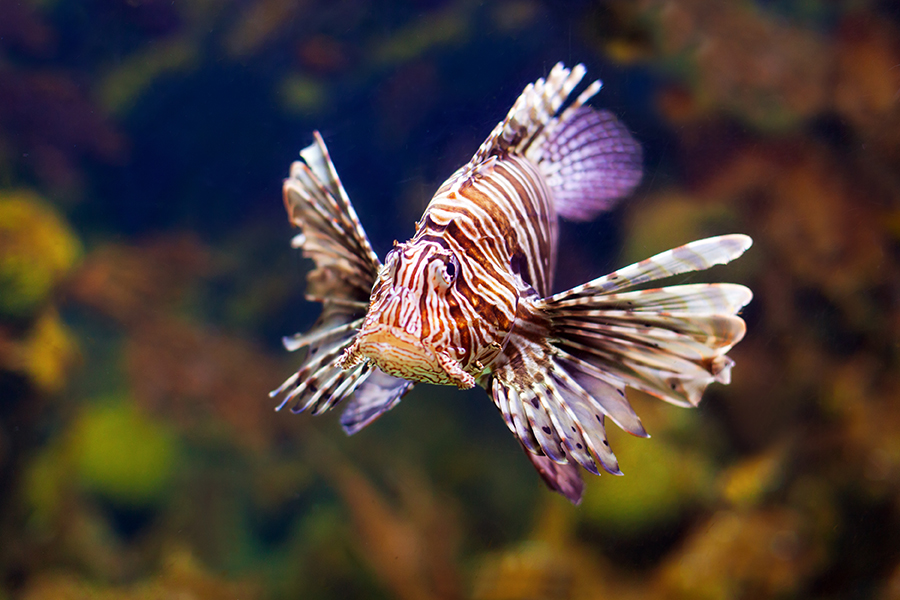
Then, about thirty years ago, some specimens escaped from an aquarium in Florida and ended up in the Atlantic. In just a few years, the lionfish (Pterois miles and Pterois volitans) became a household name throughout the Caribbean Sea, with serious consequences for the balance of local ecosystems. But the typical behavior of young fish, who leave their birth sea early to settle elsewhere, also brought some lionfish to the Suez Canal, and from there, their passage to the Mediterranean encountered no obstacles. Thus, since the second decade of this century, they have officially entered the list of “aliens” in the Mediterranean.
Specimens of the genus Pterois, belonging to the two species that have only recently been recognized as distinct (miles and volitans), have begun to take possession of the easternmost waters, between Lebanon, Syria and Turkey, then Cyprus. In that area since 2013, sightings have become increasingly frequent, not only of single specimens, but even of schools, which is indicative of a significant presence, considering that it is a fish with a usually solitary behavior, which rarely aggregates. And for some years, from the eastern Mediterranean there has been a progressive shift towards the west, certainly favored by the increase in temperatures that is being recorded throughout the basin, being a tropical species.
The seas of the Peninsula have not been excluded from this expansion. The first sightings of Pterois date back to 2016, in south-eastern Sicily. Then, other specimens were identified, always solitary, in Sardinia and again in Sicily. With an increase between 2020 and 2022. In the summer of 2023 a scorpion fish was caught in Le Castella, Calabria, by professional fishermen at about 24 meters deep and on June 25 another was photographed at 12 meters, again in Calabria, in Marina di Gioiosa Ionica, by an underwater photographer who promptly reported the alien presence. And in 2024 another sighting was made known in the sea of ??Puglia. All valuable contributions also for the research groups that study "alien" species and their expansion in the Mediterranean.
Subject, among other things, of a study conducted by the Dutch University of Wageningen and published in the scientific journal “NeoBiota”, which explains how the rapid spread in the Mediterranean represents a danger for the ecosystems here as has already happened in the Caribbean Sea. In consideration of this recognized danger for the ecological balances of our sea, research projects are underway, which include monitoring the spread of that and other alien species, also using the contribution of the many frequenters of the sea, non-scientists, through Citizen Science.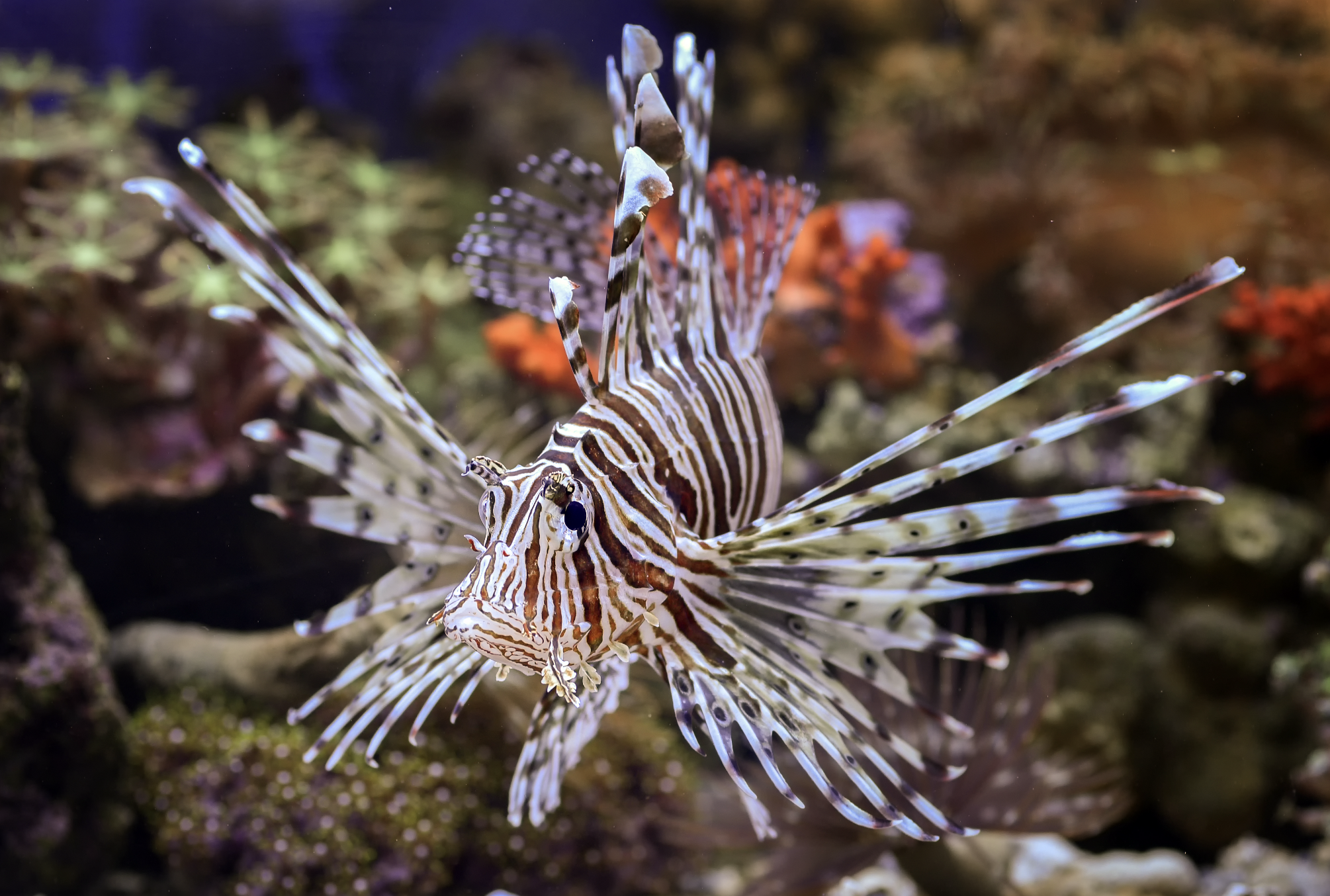
They have a small head, but a large mouth and protruding eyes surmounted by two growths like those found around their chin and used to confuse them with corals, which like them live in rocky habitats. Pterois are mimetic fish, which also use their splendid brown and white striped livery for this purpose, a characteristic alternation of colors also on the fins, which contribute to the recognized beauty of the animal during movement. But the fins also contain the peculiarity that makes scorpion fish dangerous for humans too. On the dorsal fin there are thirteen hollow spines and three more are present on the anal fin: all serve to inoculate poison into enemies from which the Pterois feel attacked. . The spines are connected to a venom gland, from which they “feed” the neurotoxin that remains active for up to 48 hours after the death of the scorpion fish. It is also a dangerous poison for humans that, in the event of a sting, causes great pain and poisoning that can be very serious and that, in some rare cases, has even proved fatal. Therefore, you must be very careful in the event of an encounter with a Pterois and avoid any close contact, even if it is an animal that tends to hide and blend in with the surrounding environment, attacking only when it feels in danger.
The genus Pterois includes ten different species, all tropical, which, despite having great adaptability, live in rocky habitats and coral reefs, usually at low depths, up to 150 meters at most. The Pterois is a nocturnal predator, which feeds on small fish, crustaceans and molluscs. Being very voracious, its massive presence has proven to be extremely destructive outside its original range, where, instead, it plays a valuable role in the food chain and in maintaining the balance of the different populations of sea inhabitants.
Careful to remove the poisonous spines, its meat is edible and therefore, in order to contain its proliferation, it is fished and marketed in the Caribbean Sea, but also in Turkey and Cyprus. Great attention is paid to research on its neurotoxin, for possible applications in the field of medicine.
Page 2 of 2


Copyright © 2026 Mare.it. All rights reserved.
The texts published on this site have not been generated by AI (Artificial Intelligence).